Search
Many of the deportees were artists and painters. Some of them were taken to a painting studio, the Malerstube. Unfortunately, they were not able to give free rein to their creativity there. Instead, they were tasked with painting transport numbers on the badges worn by the prisoners. They were also made to paint portraits of guards and their mistresses. The artists also secretly painted scenes of daily life in the Dossin barracks and portraits of their fellow prisoners.
One of the prisoners who was made to work in the Malerstube was Irene Spicker. She was selected for her exceptional painting talent.
Spicker was born in Germany in 1921. In April 1939, she fled from Berlin to Brussels with her sister Gerda. A few months later, their father, Moses, joined them. Werner Spicker, the only son of the family, was able to obtain a visa and left for Latin America. By then, the children’s mother, Margarete, had died. When the Germans invaded Belgium in 1940, life changed dramatically for the family. In 1942, Irene, Gerda and Moses went into hiding. Irene assumed a false identity, going by the name of Marie-Antoinette van Crombrugghe de Loringhe and working as a cleaner for several families. She also painted scarves to make some money on the side.
In November 1942, the Nazis were able to track her down, and she was arrested in one of the homes where she was working as a cleaner. In an attempt to find out where her sister and father were hiding, the Nazis interrogated Irene, but she refused to divulge any information. In March 1943, Irene was transferred to the Dossin barracks. She was just 22 years old at the time. Her name was added to several deportation lists (Transport XX, Transport XXI, Transport XXII A and Transport XXIII). Unlike so many other prisoners, however, she was never put on a train.
Along with other artists, she was assigned to the Malerstube. She remained in the barracks for about one and a half years until it was liberated in 1944. In 2019, the square in front of the museum was renamed Irene Spickerplein in tribute to the since deceased painter.
Besides Irene, Léon (Lon) Landau was also required to work in the Malerstube. Léon was a set designer at the Koninklijke Nederlandse Schouwburg, a theatre in Antwerp. He was taken to the Dossin barracks in January 1943, just a few months before Irene. After a year, he was put on Transport XXIV in April 1944, just a few months before the liberation. Léon Landau did not return home. After his deportation, his art stayed in the Dossin barracks. During his time there, he created a dozen puppets, drawing inspiration from the folktale of Tijl Uilenspiegel and other fairy tales. You can see one of these puppets in the memorial of Kazerne Dossin. After the liberation of the Dossin barracks, Irene Spicker took some of his artworks with her.
Carol Deutsch was sent to the Dossin barracks just a few months after Irene Spicker. Deutsch was a painter from Ostend. He later moved to his hometown of Antwerp with his wife and daughter. However, the family was continually on the run from the Nazis. Carol Deutsch’s daughter and mother-in-law hid from the Nazis in plain sight, adopting a false identity. However, Carol and his wife, Fela, were arrested and taken to the Dossin barracks. After a few days, they were put on Transport XXII B. At Auschwitz-Birkenau, Carol was employed as a painter of the barracks for some time. He was murdered in Buchenwald in late 1944. Fela also did not survive the war.
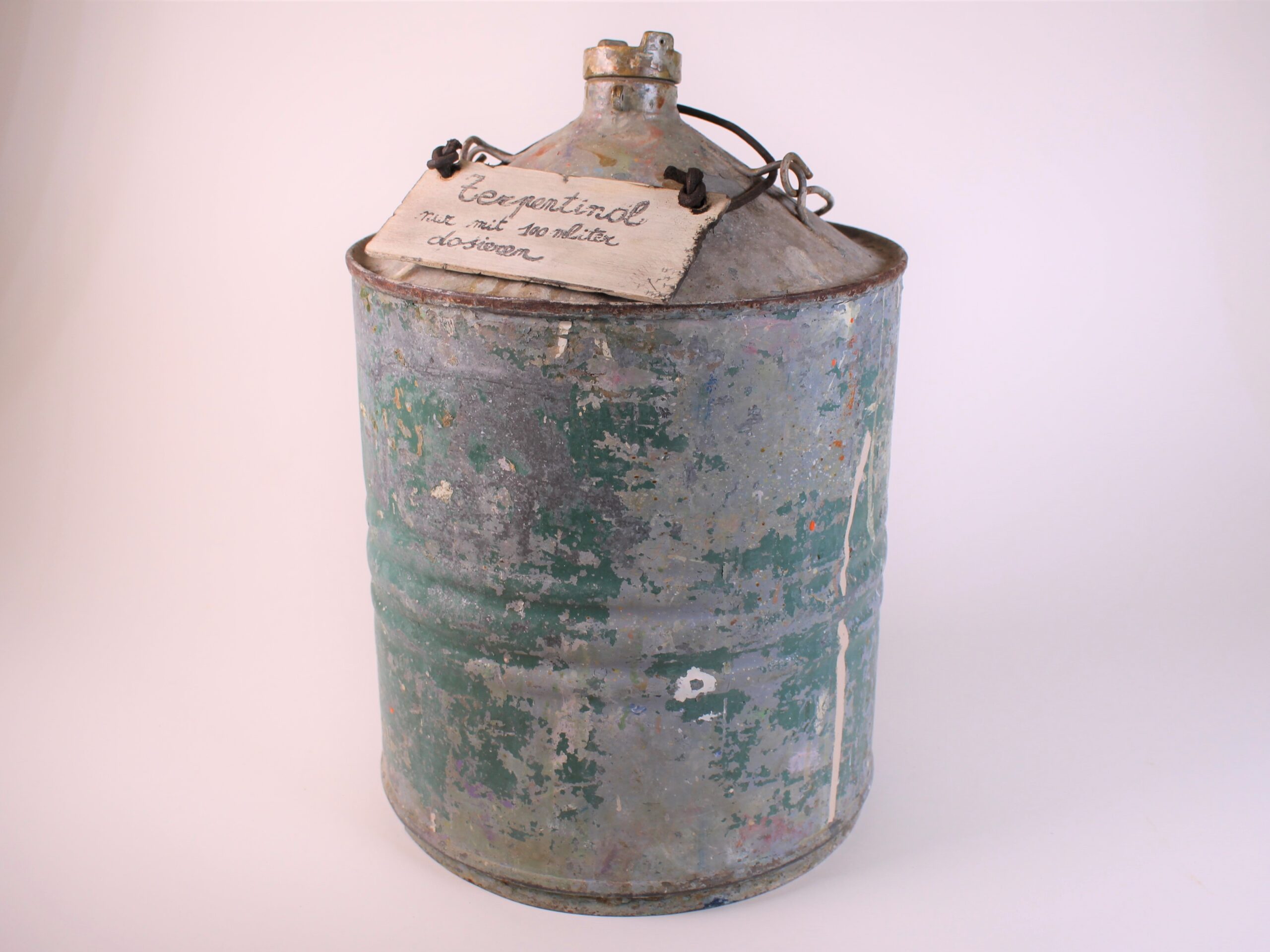
This bottle once contained turpentine. The label attached to its neck reads “Terpentinol- nur mit 100 mlitter dosieren” in incorrect German (turpentine-only distribute by 100 millilitres). Turpentine was used to thin oil paints. This bottle was presumably used in the Malerstube. Turpentine was rationed, which explains the 100 millilitres. The fragments of paint around the bottle opening suggest this bottle may have been used in the painter’s studio.
The bottle was found in the Dossin barracks in late 1944. Calixte and Emile Vandevelde, two brothers who both worked for the “Regie voor Telefonie en Telegrafie” (the Belgian national telephone and telegraph company), inspected vacant buildings that were occupied by German services during the war as part of their duties. They were also assigned to work in the Dossin barracks. They took some of the items they found there home to use them. Calixte made lists of the objects they found, recording them in two notebooks. In 2011, Calixte Vandevelde donated the original objects to his grandson Jo Peeters. Jo also recovered the items that Emile Vandevelde’s widow had kept. In 2023, Jo and his wife, Sophie Van Krunkelveldt, loaned objects from their collection to Kazerne Dossin. That is how this turpentine bottle ended up in this display case.
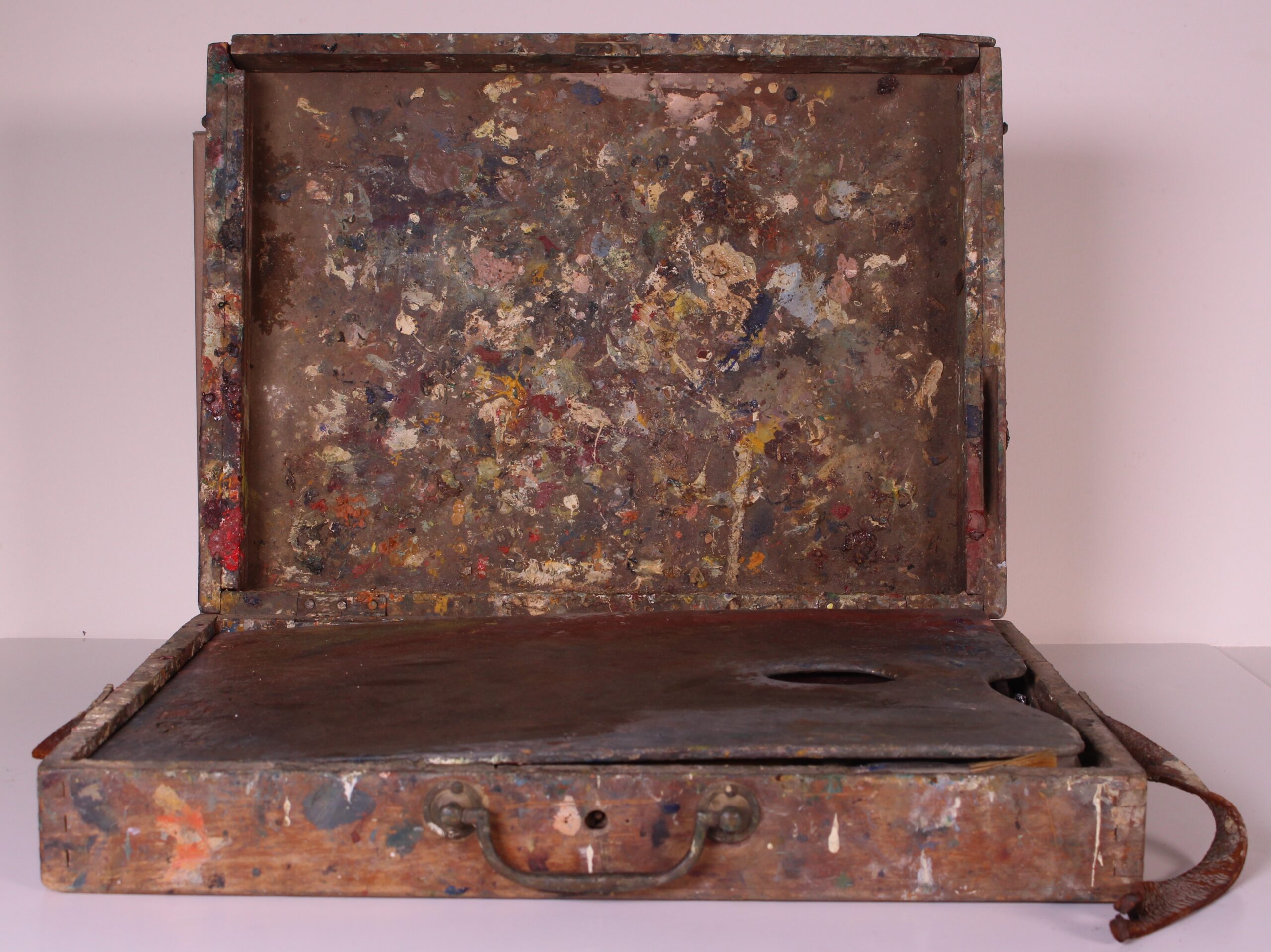
Although Carol Deutsch’s time in the Dossin barracks was short, he did meet Irene Spicker there. He gave her this paint box. This is one of the items Irene took with her after the liberation of the Dossin barracks. The paint box was donated to Kazerne Dossin by Uziel Awret, the son of Irene Spicker and her husband, Azriel Awret.
Today, there are only a handful of artworks that we know for sure were created in the Dossin barracks. There may have been more, but they were either destroyed or lost. One of these remaining artworks is Irene Spicker’s ‘Boy with Cap’. The boy has never been identified. Irene created this painting during her imprisonment at the Dossin barracks. The little boy was deported and presumably did not survive.